How to Name Your Emotions and Feelings Without Fixing Them
How to name your emotions—a 90-second affect-labeling practice to name feelings, soften intensity, and stop treating every emotion like a problem to solve.
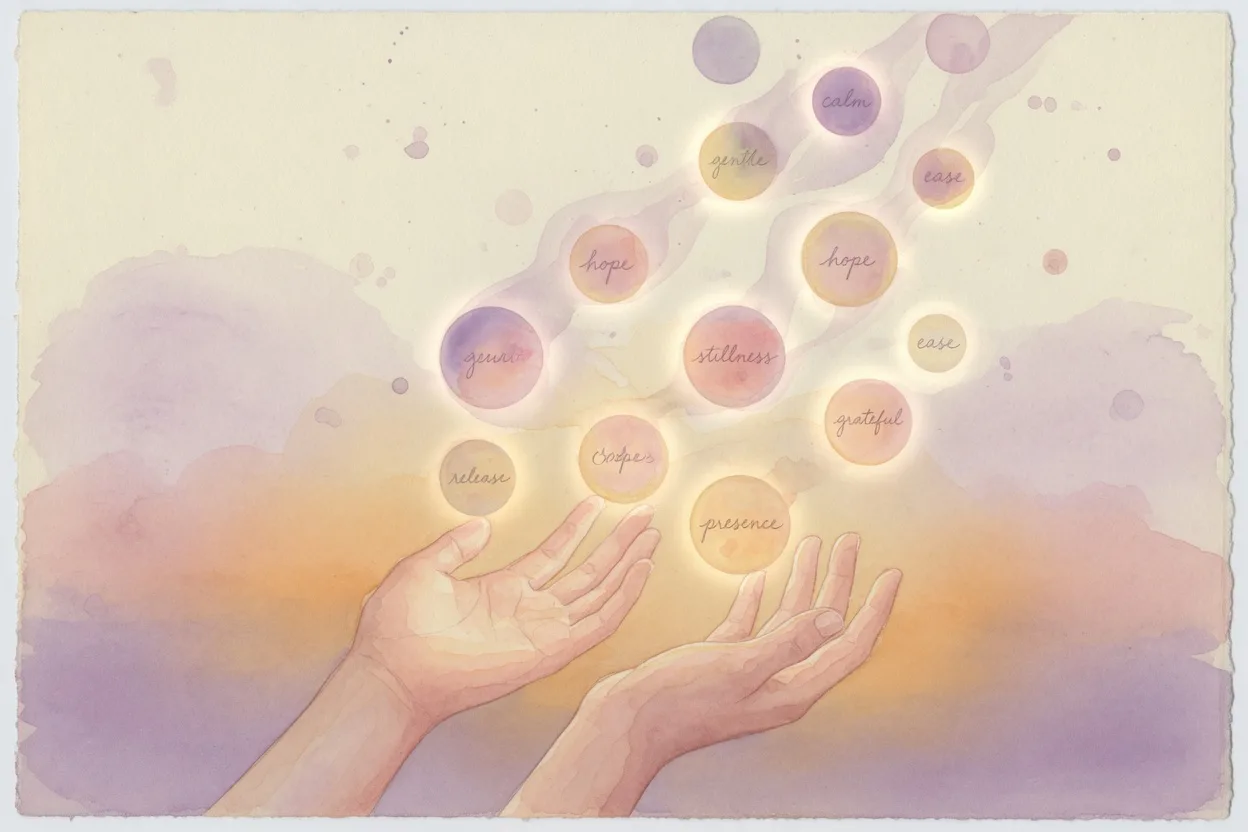
Most of us learned to handle emotions the way we handle a crowded inbox: scan, label, clear. Anxious? Breathe. Sad? Distract. Angry? Be nice. Overwhelmed? Push through.
The tools themselves are not always wrong. The damage is in the order. We skip the middle step — recognition without renovation — and treat every inner weather report as a ticket that must be closed before lunch.
This essay is about that middle step: how to name your emotions with enough precision that your body starts to believe you are not in an emergency — and how to stop confusing understanding with fixing. If "fine" is your only word, also see "I'm fine" as a survival skill. If you want a vocabulary map first, try the mood word finder.
Why vague names keep emotional intensity high
When language is blunt, the nervous system stays blunt.
- “I’m fine” often means: I don’t have bandwidth for the truth here.
- “I’m stressed” often means: something is too much, but I haven’t sorted what.
- “I’m a mess” is not a feeling — it is a verdict about the self.
Vague names force the brain to keep scanning. Specific names give it a map. Clinical and lab work on affect labeling (putting words to affective states) keeps pointing in a similar direction: when people find a more accurate word for what they feel, the intensity of the feeling often softens slightly. Not because language is magic, but because the brain can stop treating the sensation as pure threat and start treating it as information.
“I’m bad” is a court sentence. “I’m disappointed, a little lonely, and embarrassed that I care this much” is a landscape.
Verdicts trap you. Landscapes let you move.
Why we rush to fix
If naming feels hard, it is rarely because you are “bad at feelings.” More often, one of these is true:
- Speed was safety. In some families or workplaces, pausing to feel looked like weakness, drama, or delay.
- Fixing is identity. Being the competent one means never sitting with an unfinished emotion.
- Precision feels exposing. A fuzzy “tired” protects you. A clear “hurt and discarded” risks being seen.
- You only have two settings. Either numb — or flooded. There is no practiced middle.
None of these are moral failures. They are adaptations. The goal is not to shame the adaptation; it is to update it when life becomes safer than it used to be.
What “good enough” naming looks like
You do not need a therapist’s vocabulary list memorized. You need honesty at the resolution you can currently afford.
Useful names are often:
- Body-first: tight chest, hot face, hollow stomach, heavy limbs
- Relational: left out, cornered, unseen, controlled, needed-too-much
- Mixed: grateful and resentful; calm and lonely; proud and afraid
Permission slips that matter:
- “Numb” is a real state.
- “Mixed” is allowed.
- “I don’t know yet” is still a name — it means I’m staying present without lying.
Mood tracking works best when it is curious, not correct. The goal is not a perfect emoji. The goal is a relationship with yourself that includes rain, not only sunny days. For a habit that does not become a chore, see build a mood tracking ritual.
A name is not a diagnosis. It is a door you can walk through gently — and leave open behind you.
A practice: the 90-second naming loop
Use this when a wave hits at work, in a message thread, or alone at night. Keep it shorter than your urge to “solve.”
Locate (20 seconds)
Where is it in the body? Jaw, throat, chest, belly, hands, behind the eyes? If you cannot find it, say “nowhere specific” — that is data too.
Widen (30 seconds)
Offer two or three candidate words, not one. Irritated or hurt? Embarrassed or angry? Tired-of-trying or hopeless? Let the body “vote” by noticing which word softens or sharpens the sensation.
Hold (20–30 seconds)
Stay with the best-fit name without fixing. No plan. No pep talk. Just: this is here.
Ask only after (20 seconds)
Now — and only now — ask: water, boundary, walk, message, sleep, food, quiet, human contact? Need is allowed to be small.
That pause is not indulgence. It is the opposite of emotional repression and of emotional drama: neither stuffing nor performing.
Common traps (and gentler exits)
Trap 1: Naming as self-attack
“I feel anxious” becomes “I’m so pathetic for being anxious.” Exit: Keep the sentence structure I feel ___ / There is ___ in me. Leave character assassination out of the grammar.
Trap 2: Naming as analysis essay
You write three paragraphs of why the feeling is logical. Exit: One sentence of name + one sentence of body. Analysis can wait until the wave is smaller.
Trap 3: Naming as a demand on others
You name the feeling only to make someone else change immediately. Exit: First name it for you. Then decide whether a request is wise.
Trap 4: Waiting for the perfect word
You freeze because no word is 100% right. Exit: Use a “placeholder with honesty”: something like grief, not sure yet.
How this shows up in a mood log
A thin entry:
Mood: bad. Note: day was bad.
A living entry:
Mood: sad + tired. Intensity 6. Note: Chest heavy after the meeting. Named it: “left out, not furious.” Needed quiet, not advice.
The second entry is a letter to future-you. Future-you will not need a perfect prose style. Future-you will need specificity — enough to recognize the pattern the next time the same weather returns.
If you use MoodEvo, treat the check-in as a 30-second act of orientation, not a performance review. Intensity can be approximate. Tags can be incomplete. The relationship is the point.
When naming is not enough
Naming is a doorway, not the whole house.
If you are in crisis, unsafe, or cycling through thoughts of harming yourself, precise vocabulary is not the primary tool — support and safety are. Reach a person or local emergency resource you trust. Emotional literacy never replaces professional care when the water is over your head.
For everyone else: if naming reliably leads to rumination that lasts hours, shorten the practice and add body discharge (walk, cold water, longer exhales) before more words.
Sources and scope
- Lieberman et al. (2007), “Putting Feelings Into Words”, examined affect labeling and emotional reactivity in an fMRI study.
- The World Health Organization’s *Doing What Matters in Times of Stress* includes noticing-and-naming and grounding skills.
These sources support naming as a potentially useful regulation skill; they do not show that naming works equally for everyone or replaces clinical care.
Common questions
How do you name your emotions?
Start with the body, not a verdict. Locate the sensation (jaw, chest, belly), offer two or three candidate words, and let the body vote. “Disappointed and a little lonely” is a name. “I’m a mess” is a court sentence. The 90-second loop above is the whole method: locate, widen, hold, then ask what you need.
What is the difference between naming emotions and fixing them?
Naming is recognition without renovation. Fixing is the next step—water, a boundary, a walk, a message—and it works better after the feeling has a map. If you skip naming, the nervous system keeps scanning. If you only name and never ask what you need, you can rumination-loop. Order matters: name first, then choose a small need.
Are feelings nouns?
Some are (“sadness,” “anger”). Many useful names are not: mixed states, body facts (“tight chest”), or relational words (“left out”). You do not need a grammar rule. You need a phrase your body recognizes. “Something like grief, not sure yet” still counts.
What if I only have the word “fine”?
“Fine” is often a protector, not a feeling. See “I’m fine” as a survival skill. When you have a little more room, try one notch more specific: tired, braced, numb, disappointed. The mood word finder can offer candidates when the list in your head is only two words long.
A closing invitation
You can live a whole life fluent in other people’s needs and illiterate in your own. Many of us did — for good reasons.
Updating that literacy does not require becoming dramatic, poetic, or permanently “healed.” It requires a quieter skill: telling the truth at a scale your nervous system can hold.
Start with one wave. One word that is truer than “fine.” One breath where you do not rush the renovation.
The repair can come later. Recognition is already a form of care.
Try a 30-second check-in
Name the mood, set intensity, optional note — enough for today. Curiosity over correctness.
When you're ready
Name one feeling. That's enough for today.
MoodEvo is a gentle place to notice how you feel in under a minute — no fixing, no streak guilt.
Continue reading
Rumination vs Reflection: How to Tell a Loop from a Useful Look
Rumination vs reflection—why the mind replays the same conversation, how “why” keeps you stuck, and a four-step way to step off the carousel.
“I’m Fine” Is Sometimes a Survival Skill
Emotional numbness and saying “I’m fine” can be protective, not denial. Learn trauma-informed thawing, safer pacing, and how to track gradual honesty.

Build a Mood Tracking Habit That Isn’t a Chore
How to design a daily mood journal ritual without streaks guilt—minimal check-ins, energy templates, and soft restarts after missed days.